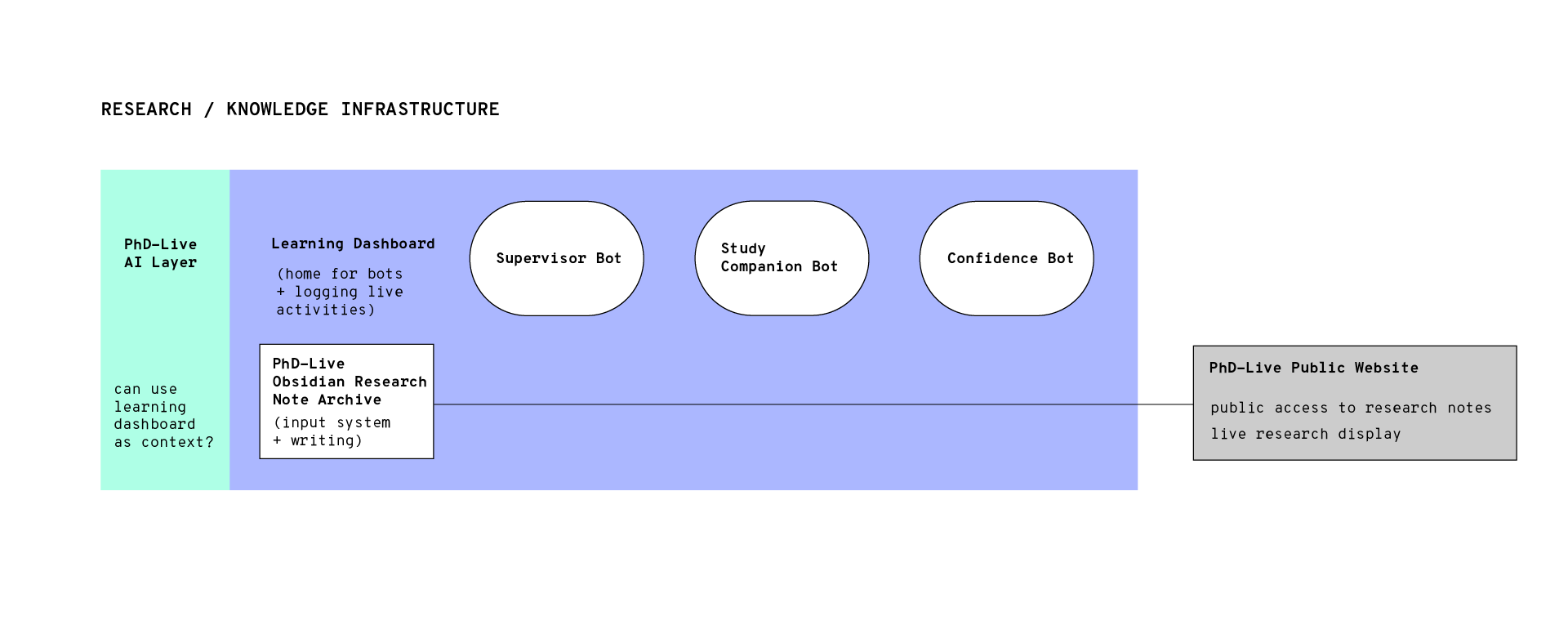
the obsidian vault acts a basis that feeds into an intrinsic shared-context-layer which acts as additional contextual information for all components of the research infrastructure.
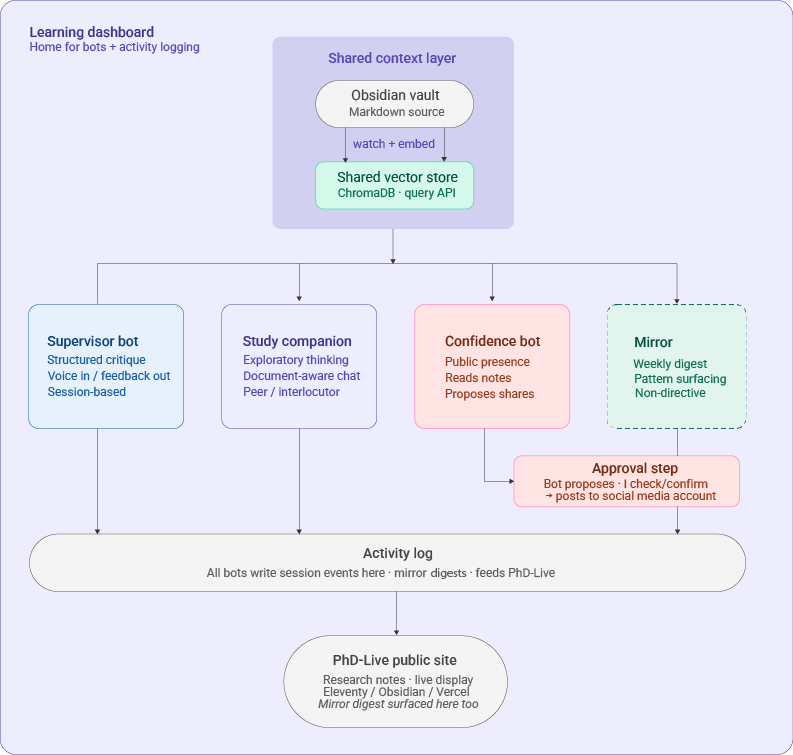
most recent diagram
following session 2026-04-17, the ‘research infrastructure’ was born.
Research / knowledge infrastructure: key decisions
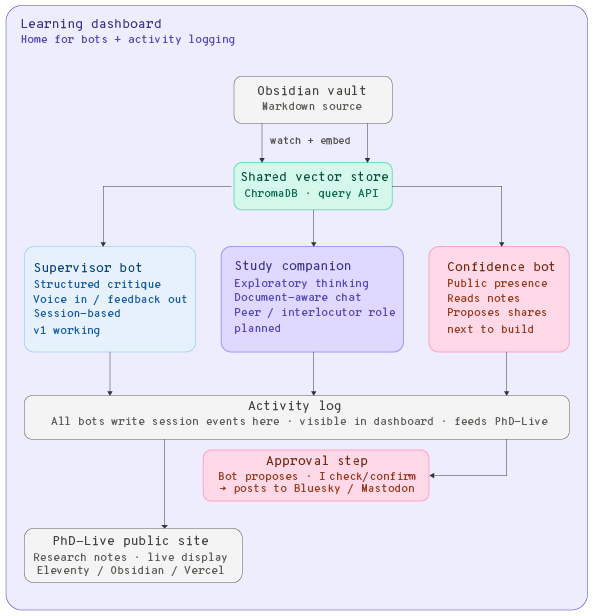
initial diagram of research infrastructure
### Build approach
Custom FastAPI + frontend approach.
(Off-the-shelf options (LibreChat, AnythingLLM, Chainlit) don’t accommodate the non-chat interaction paradigms that I am interested in exploring).
general logic - don’t build ‘plumbing’ that already exists; but build the interface layer myself
One vector store (ChromaDB or SQLite + embeddings), one query API, all bots consume it. Sequence: watcher → embed → query endpoint → wire supervisor bot → build confidence bot on top. Chunk by Obsidian heading structure.
(RAG-compatible by design; fuller retrieval can be added later as extension).
Shell first (navigation + activity feed), which can become knowledge layer second.
I will let real usage generate signal before designing potential context features of this dashboard.
Document this sequencing decision - the reasoning is important research material (ie. why starting from shell first, seeing what emerges as I use it before adding more features)
Activity log (exists only on phd-live site? or also on the learning dashboard)
Three distinct things, kept separate:
Session record — structured log per bot interaction (local store)
Research diary layer — interpretive, themes, trajectory (future)
Public feed — curated subset surfaced to PhD-Live (separate concern)
Open questions
Does the learning dashboard become a context source for bots, and when?
What is the “shareable” threshold logic for Confidence Bot?
Does the activity log feed PhD-Live automatically or via curation?
Revision history
11 revisions
The revisions below show how this note has changed over time.
aliases:- research infrastructureprogess and updates kept here: [[system-map]]----
[[learning-dashboard]][[project-supervisor-bot]][[study-companion-bot]][[confidence-bot]]- [[learning-dashboard]]- [[project-supervisor-bot]]- [[study-companion-bot]]- [[confidence-bot]]as well as connecting to my obsidian vault and the website (the [[project-phd-live-platform]])as well as connecting to my obsidian vault and the website (the [[project-phd-live-platform|phd-live platform]])[[shared-context-layer]]the obsidian vault acts a basis that feeds into an intrinsic [[shared-context-layer]] which acts as additional contextual information for all components of the research infrastructure.<figcaption>most recent diagram<figcaption>following session [[2026-04-17]]following session [[2026-04-17]], the 'research infrastructure' was born.<figcaption>initial diagram of research infrastructure</figcaption>Custom FastAPI + frontend remains correct.Custom FastAPI + frontend approach.These map onto three modes of cognitive/emotional labour in PhD research.This is worth naming explicitly in the thesis framing.These map onto three modes of cognitive/emotional labour in PhD research. -> This is worth naming explicitly in the thesis framing.### Shared context layer (build this first)### [[shared-context-layer|shared context layer]]### Learning dashboardShell first (navigation + activity feed), which can become knowledge layer second.Let real usage generate signal before designing potential context features of this dashboard.### [[learning-dashboard|learning dashboard]]Shell first (navigation + activity feed), which can become knowledge layer second.I will let real usage generate signal before designing potential context features of this dashboard.Document this sequencing decision - the reasoning is important research material (ie. why starting from shell first, seeing what emerges as I use it before adding more features)*Document this sequencing decision - the reasoning is important research material (ie. why starting from shell first, seeing what emerges as I use it before adding more features)*### Activity log (AI layer as I have been calling it in provisional sketches)### Activity log
and connects to the obsidian vault for contextas well as connecting to my obsidian vault and the website (the [[project-phd-live-platform]])
<!--Quick syntax:Session: start:: YYYY-MM-DD HH:MM+ZZ | end:: ... | topic:: ...Milestone: - [ ] Thing #milestone @YYYY-MM-DDCORE TYPES:• Turn into blog post → add: type: postFEATURE & NAVIGATION TAGS:• featured → appears in Featured section on homepage• gardenEntry → appears as a trailhead in the Garden gatewayLIVE SYSTEM TAGS:• session → used for live sessions / work periods• daily → daily log style notesOne vector store (ChromaDB or SQLite + embeddings), one query API, all bots consume it. Sequence: watcher → embed → query endpoint → wire supervisor bot → build confidence bot on top. Chunk by Obsidian heading structure. RAG-compatible by design; fuller retrieval can be added later as extension.One vector store (ChromaDB or SQLite + embeddings), one query API, all bots consume it. Sequence: watcher → embed → query endpoint → wire supervisor bot → build confidence bot on top. Chunk by Obsidian heading structure.(RAG-compatible by design; fuller retrieval can be added later as extension).
Custom FastAPI + frontend remains correct. Off-the-shelf options (LibreChat,AnythingLLM, Chainlit) don't accommodate the non-chat interaction paradigms that I am interested in exploring.Custom FastAPI + frontend remains correct.(Off-the-shelf options (LibreChat, AnythingLLM, Chainlit) don't accommodate the non-chat interaction paradigms that I am interested in exploring).
conversational supervisor bot for conversations in meetingsand'traditional' LLM chatbot for my queries, questions and support